
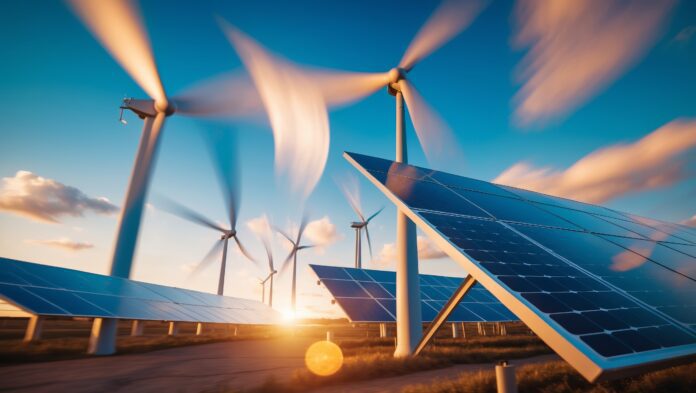
Spain could become one of the few economies in the European Union capable of counteracting rising energy prices thanks to massive investments in wind and solar power over the past six years. According to Euronews, with information cited by Economedia, these investments have significantly reduced the country’s dependence on fossil fuels and lowered electricity prices.
Global energy markets have recently been shaken by geopolitical tensions involving Iran. Concerns over the closure of the Strait of Hormuz and reduced energy exports from the Middle East have raised fears of rising energy bills across Europe.
However, Spain appears to be better positioned than many other EU countries to absorb such shocks. Since 2019, the country has doubled its wind and solar capacity, adding more than 40 GW of renewable power—more than any EU country except Germany, whose electricity market is roughly twice the size of Spain’s.
Read also: Eurowind Energy plans a €65 million hybrid wind–solar park in Romania
Renewables reduce gas dependence
The rapid expansion of renewable energy has significantly reduced the role of gas in determining electricity prices. According to a report by the energy think tank Ember, the growth of wind and solar power has cut the influence of expensive fossil fuel generators on electricity prices by 75% since 2019.
Between 2020 and 2024, Spain also reduced its energy import bill more than any other EU country by adding new wind and solar farms, avoiding the import of 26 billion cubic meters of gas, worth around €13.5 billion.
A key milestone occurred in August 2025, when Spain produced no electricity from coal, a sharp contrast with the situation a decade earlier, when coal accounted for roughly a quarter of the country’s electricity generation.
Lower electricity prices
These investments have helped reduce energy costs for households. While Spain once had some of the highest electricity prices in Europe in 2019, it now ranks among the countries with the lowest.
According to Ember analyst Chris Rosslowe, Spain began 2026 with some of the lowest electricity prices in Europe, a trend that continued during the first weeks of the year.
However, the country still needs to expand its energy storage capacity, as its battery storage system—currently around 120 MW—ranks only 13th in Europe.
Clean energy offers long-term stability
Experts say energy systems heavily dependent on fossil fuels remain vulnerable to geopolitical shocks and price volatility. António Guterres, Secretary-General of the United Nations, warned that recent turmoil in the Middle East highlights the fragility of a global energy system reliant on fossil fuels.
Unlike oil and gas, which must be purchased continuously, renewable technologies such as wind turbines and solar panels involve one-time investments, making energy systems more resilient to market fluctuations.
Photo: freepik.com